
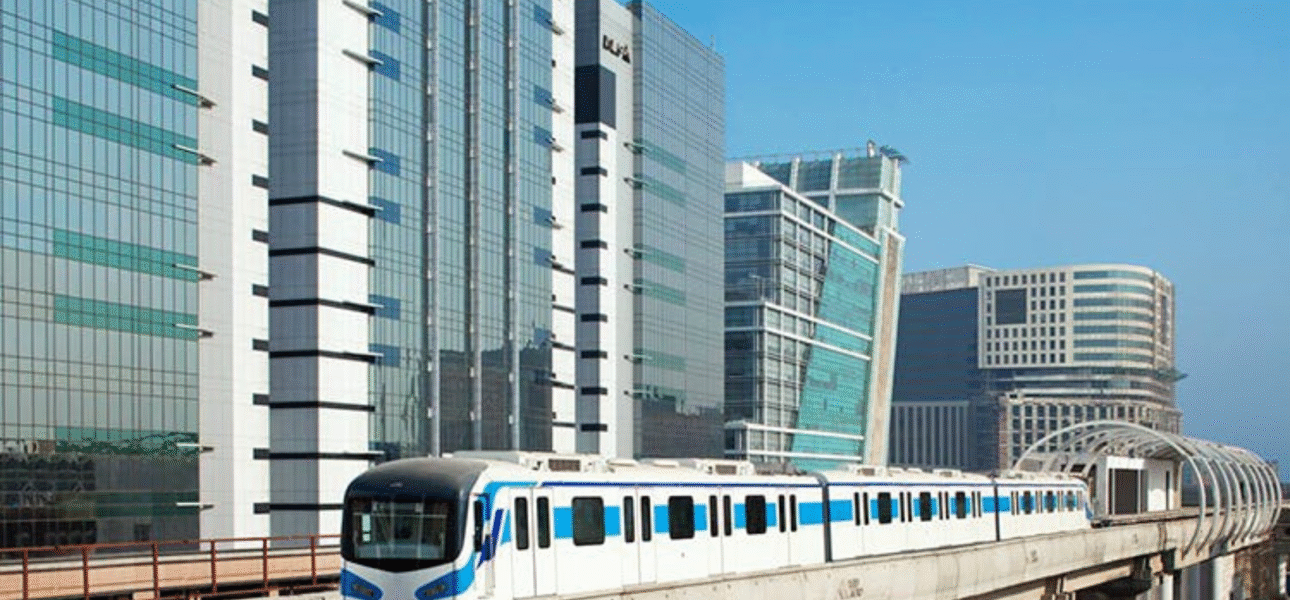
Gurugram’s rise as a premier office destination in India has always been closely linked to infrastructure. From expressways to arterial roads, every leap in connectivity has reshaped how occupiers evaluate location, cost, and workforce accessibility. Among these drivers, the Rapid Metro expansion stands out as a defining upgrade—one that is quietly but decisively influencing office demand, rental behaviour, and long-term leasing strategies.
As businesses recalibrate their workplace models and investors focus on resilience rather than speculation, connectivity has emerged as the new currency of commercial real estate. The expansion of the Rapid Metro is not merely improving transit—it is redefining how Gurugram’s office market functions.
Gurugram’s Office Evolution: Infrastructure Before Everything Else
Over the last two decades, Gurugram has transitioned from a satellite town into a fully-fledged corporate ecosystem. What differentiates it from competing office markets is not just the availability of Grade-A supply, but the city’s ability to integrate infrastructure with commercial growth.
Early office clusters flourished around NH-48 and Cyber City because they were accessible. As development moved outward, locations that lacked reliable connectivity struggled to attract sustained demand, regardless of building quality. This historical pattern makes one thing clear: office demand in Gurugram has always followed transit lines.
The Rapid Metro expansion reinforces this trend, offering seamless internal movement and improved integration with the wider Delhi NCR network.
Why Rapid Metro Expansion Is a Market-Changer
The Rapid Metro was conceived to solve a specific problem—last-mile connectivity within Gurugram’s key business corridors. Its expansion now addresses a broader challenge: enabling decentralised yet efficient office growth.
By extending access to emerging commercial zones and reducing dependency on road-based travel, the expanded network enhances the functional geography of the city. Office locations that were previously considered secondary are now viable, not because rents are lower, but because connectivity has reduced the perceived distance.
For occupiers and investors alike, this changes how risk, value, and long-term viability are assessed.
Office Demand and Employee-Centric Decision Making
In the post-pandemic environment, office location decisions are no longer driven solely by corporate leadership. Employee experience has become central, and commute time remains one of the strongest predictors of attendance and retention.
Improved metro connectivity allows organisations to draw talent from a wider NCR catchment without increasing commute stress. This has made metro-accessible buildings significantly more attractive for companies looking to stabilise attendance under hybrid work models.
As a result, buildings near Rapid Metro stations are experiencing faster leasing velocity and lower friction during negotiations—particularly for mid to large-format occupiers.
Rental Behaviour: Stability Over Aggression
One of the most noticeable impacts of metro expansion is its influence on rental behaviour. Rather than sudden spikes, metro-connected office assets demonstrate greater rental stability.
Landlords benefit from:
- Higher quality tenant profiles
- Lower vacancy cycles
- Better renewal probabilities
Tenants, on the other hand, are more willing to commit to reasonable escalations when the location delivers sustained value through accessibility.
This equilibrium has made well-connected assets increasingly attractive for firms seeking structured leasing outcomes supported by office space transaction advisory in Gurugram, where location fundamentals outweigh short-term cost arbitrage.
Connectivity and the Shift Toward Smarter Leasing Strategies
As the market matures, leasing decisions are becoming more data-driven. Corporates are no longer asking only “What is the rent?” but “How does this location perform over a five- to nine-year lease cycle?”
Rapid Metro expansion strengthens confidence in:
- Long-term workforce accessibility
- Predictable operating costs
- Scalability within the same corridor
This has encouraged occupiers to commit to longer tenures and invest more meaningfully in fit-outs—an important signal of market confidence.
Such strategic leasing decisions are often supported by end-to-end office lease support in Gurugram, ensuring alignment between location, commercial terms, and future expansion potential.
Decentralisation Without Dilution
Traditionally, decentralisation in office markets has been associated with compromise—lower rents but weaker infrastructure. Rapid Metro expansion challenges that assumption.
Emerging office corridors now offer:
- Comparable accessibility to core locations
- Modern building stock
- Better parking and campus-style environments
This has led to a more balanced distribution of demand across the city, easing pressure on traditional hubs while unlocking value in newer zones.
For occupiers, this creates genuine choice. For the city, it creates a healthier, more sustainable office ecosystem.
Investor Perspective: Connectivity as a Risk Filter
From an investment standpoint, connectivity is no longer an upside—it is a prerequisite. Assets that lack mass transit access face increasing scrutiny, particularly as tenant expectations evolve.
Metro-connected buildings benefit from:
- Stronger exit liquidity
- Higher institutional interest
- Better downside protection during market corrections
This makes infrastructure assessment a critical component of asset evaluation, often led by a commercial due diligence firm in Gurgaon that can identify both immediate and future connectivity advantages.
Leasing Advisory in a Connectivity-Led Market
As Gurugram’s office market becomes more nuanced, advisory roles are evolving. The focus has shifted from transaction execution to strategic alignment—matching occupier objectives with infrastructure-led growth corridors.
This is especially relevant for occupiers expanding or consolidating portfolios across NCR, where investment advisory for office leasing in Delhi NCR plays a key role in balancing cost efficiency with long-term operational resilience.
Connectivity, in this context, becomes the anchor variable around which all other commercial decisions revolve.
Landlords and Developers: The Connectivity Imperative
For asset owners, proximity to metro infrastructure is no longer enough. The quality of access—walkability, safety, signage, and integration with the building experience—matters just as much.
Developers who align design, amenities, and access with metro infrastructure are better positioned to:
- Attract blue-chip tenants
- Reduce leasing downtime
- Maintain pricing power
In contrast, assets that ignore connectivity upgrades risk gradual obsolescence, regardless of their original positioning.
Gurugram’s Office Market: What the Next Phase Looks Like
The Rapid Metro expansion signals Gurugram’s transition into a networked office city, where multiple business districts operate efficiently without over-reliance on a single core.
Over the next few years, we can expect:
- Greater absorption in metro-aligned corridors
- Increased pre-leasing in well-connected developments
- More disciplined rental growth
- Stronger alignment between infrastructure and asset planning
Connectivity will not just influence where offices are located—it will determine which offices succeed.
Conclusion: Connectivity Is No Longer Optional
The expansion of the Rapid Metro reinforces a fundamental truth about Gurugram’s office market: connectivity is the foundation of demand, not a supporting feature.
As occupiers seek efficiency, employees prioritise accessibility, and investors demand resilience, metro-linked locations will continue to outperform across cycles. The future of office real estate in Gurugram will be shaped not by isolated buildings, but by how seamlessly those buildings connect to the city.
At Real Property, we work closely with occupiers, investors, and landlords to interpret these shifts—ensuring that leasing and investment decisions are informed, future-ready, and aligned with infrastructure-led growth.
In a market where every minute of commute counts, connectivity is no longer a differentiator. It is the decision.