
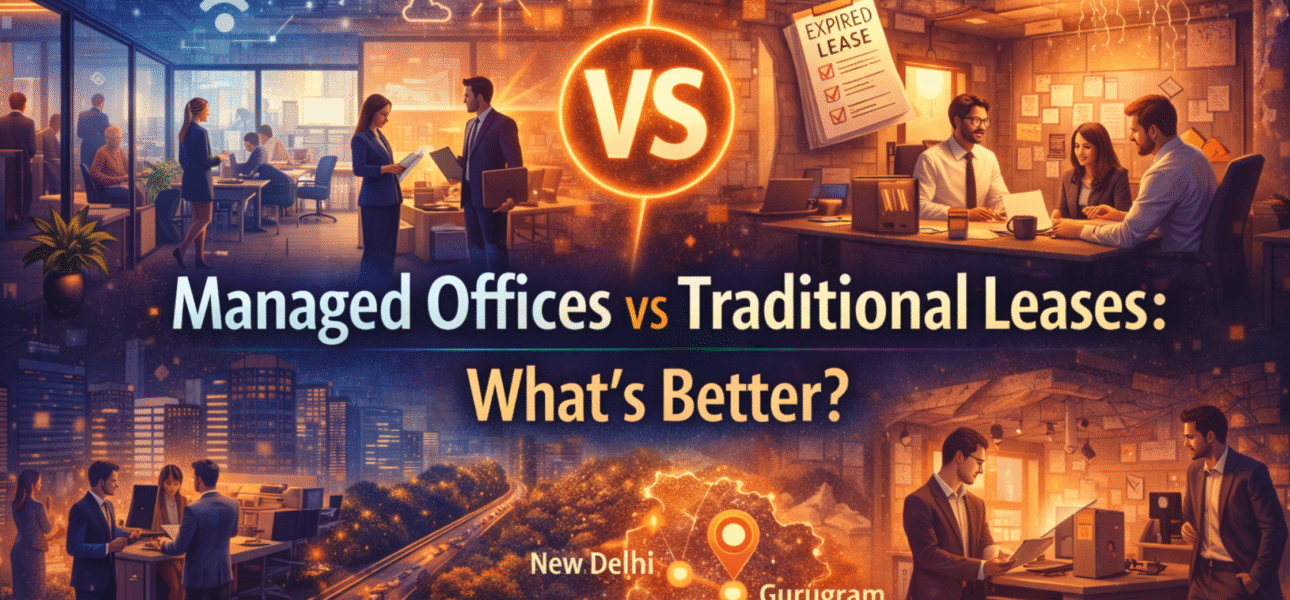
The startup founder stands at a crossroads. Option A: Lease 8,000 square feet in a commercial building, spend three months building it out, hire facilities staff, and lock in for five years. Option B: Move into a fully furnished managed office next week, pay all-inclusive pricing, and retain flexibility to expand or contract with 90 days notice.
Ten years ago, this wouldn’t have been a decision—traditional leases were the only viable option for companies beyond the 5-person stage. Today, the managed office market has evolved from executive suites and co-working into sophisticated offerings that rival or exceed traditional office quality while providing fundamentally different economic and operational models.
The question isn’t which option is “better” in absolute terms—it’s which model aligns with your specific business situation, growth trajectory, and operational priorities. Let’s examine both models honestly, exploring their real advantages, hidden costs, and strategic implications.
Understanding the True Cost Comparison
The headline number comparison between managed offices and traditional leases is misleading. Managed offices quote all-inclusive per-seat pricing that appears 40-60% higher than traditional lease rates. But you’re not comparing equivalent offerings.
Office space rental agencies near me professionals emphasize that accurate comparison requires calculating total occupancy cost, not just base rent.
Traditional lease total costs include base rent, common area maintenance (CAM), electricity (often charged at commercial rates with 30-50% markup), property tax pass-throughs, interior build-out amortized over lease term, furniture and equipment purchase, IT infrastructure installation, pantry setup and ongoing supplies, housekeeping and facilities management staff, reception and administrative support, security services, maintenance and repairs, and telecommunications infrastructure.
When you aggregate these costs, the gap between managed offices and traditional leases narrows dramatically—often to 15-25% rather than the 50%+ that headline comparisons suggest.
For companies under 50 employees, managed offices often prove less expensive because the per-seat overhead of traditional infrastructure doesn’t make economic sense at a small scale.
The Flexibility Premium
The fundamental difference between models isn’t cost—it’s flexibility versus commitment.
Traditional leases require 3-5 year minimum commitments (often 5-9 years for larger spaces). You’re betting your business won’t need to expand beyond the leased space, contract below it, relocate, or fundamentally change how you operate. That’s a bold bet in today’s volatile environment.
Commercial office leasing advisory in Delhi NCR experts note that flexibility has become increasingly valuable post-pandemic. Companies that locked into 5-year leases in 2019 for office-centric operations found themselves paying for empty space when remote work became necessary. Those in managed offices could contract or exit with minimal penalties.
Managed offices typically offer 30-90 day exit clauses and can accommodate expansion by moving to larger suites within the same building or network. This optionality has quantifiable value—the ability to respond to business changes without catastrophic sunk costs.
The flexibility premium (the additional cost for managed offices) might be 15-20%, but the value of avoiding wrong-sized space, unnecessary relocations, or trapped capital in build-outs often exceeds this premium.
Speed to Occupancy
Time has value that doesn’t appear in cost comparisons but impacts business results significantly.
Traditional lease occupancy timeline typically spans 4-6 months from lease signing to operational occupancy—lease negotiation (1-2 months), architectural planning and approvals (1 month), build-out and furniture installation (2-3 months), IT infrastructure setup (2-4 weeks), and hiring and onboarding facilities staff (1-2 months).
Managed office occupancy happens in 1-2 weeks—tour space, finalize agreement, move in. That’s it.
For growing companies, those 4-6 months represent opportunity cost. Your team is cramped in inadequate space while competitors are scaling. You’re delaying hiring because you lack space for new employees. You’re turning away client visits because your office isn’t presentable.
The ability to scale rapidly—expanding from 30 to 60 employees in a quarter because market opportunity emerged—has strategic value that’s difficult to quantify but enormously important.
Operational Burden and Focus
Running office facilities is an entire operational function that many companies underestimate until they’re managing it.
Traditional office operations require dedicated attention to facility maintenance, housekeeping coordination, vendor management for multiple services, utility account management and payment, equipment repair and replacement, compliance with property regulations, emergency response protocols, and managing the inevitable issues that arise in any physical space.
For technology companies, professional services firms, or any organization where facilities management isn’t core competency, this operational burden distracts from actual business activities.
Corporate office leasing solutions in Gurgaon clients consistently report that the “hidden” benefit of managed offices is reclaiming bandwidth previously spent on facilities management. When the air conditioning fails, you call one number and it’s handled—you don’t coordinate between the landlord, service vendors, and your own team.
This might seem trivial until you calculate the leadership time consumed managing facilities issues, the opportunity cost of distracted focus, and the risk of operational failures due to inadequate facilities expertise.
Quality and Amenity Differences
The quality spectrum in both traditional and managed offices is wide, making generalizations difficult.
Premium managed offices now rival top-tier traditional build-outs in design quality, furniture standards, technology infrastructure, and amenity offerings. The stigma of managed offices being inferior spaces is increasingly outdated—many managed offerings are now premium products targeting sophisticated companies.
Traditional offices offer complete design control. You determine layout, materials, branding integration, and every aesthetic detail. For companies where the office environment is critical to culture or brand expression, this control has value beyond cost considerations.
However, this control comes with responsibility. Your choices determine quality, and your budget constraints might force compromises that managed offices avoid through scale economies. A managed office provider furnishing 500+ seats can afford better furniture at better pricing than you can buying 50 seats.
The Financial Structure Implications
Traditional leases and managed offices create fundamentally different financial structures that impact business operations beyond real estate.
Traditional leases require significant upfront capital—security deposits (typically 6-12 months rent), build-out costs (₹800-1500 per square foot depending on finish quality), furniture and equipment purchase (₹200-400 per seat), and IT infrastructure installation (₹50-100 per seat).
For a 10,000 square foot office (approximately 100 seats), upfront investment often exceeds ₹1-1.5 crores before paying the first month’s rent.
Managed offices eliminate this capital requirement. You pay monthly fees from the operating budget with minimal deposit (typically 2-3 months). The capital that would have been locked in office build-out remains available for actual business investment—product development, marketing, hiring, or financial runway.
For startups and growth companies where capital efficiency is critical, this distinction matters enormously. Spending ₹1.5 crores on office build-out might mean forgoing two senior hires or six months of additional runway.
Scalability Patterns
The optimal model often depends on your growth pattern and certainty.
Managed offices excel when growth trajectory is uncertain or variable, you’re in rapid expansion mode (doubling annually), your space needs might contract (seasonal business, project-based work), or you want to test new market locations without commitment.
Traditional leases make sense when you have stable, predictable headcount, you’re established and growth is relatively certain, you’re at a scale where per-seat economics favor traditional models (typically 150+ employees), and you value complete environmental control and brand integration.
Many sophisticated companies use hybrid strategies—traditional leases for headquarters or stable locations, managed offices for expansion markets, satellite offices, or functions with variable headcount.
The Decision Framework
Rather than debating which model is “better,” ask which aligns with your situation.
Evaluate These Factors:
Stage and certainty: Early-stage companies with uncertain trajectories benefit from managed office flexibility. Established companies with predictable operations can optimize through traditional leases.
Growth rate: Rapidly growing companies (>30% annually) often outgrow traditional spaces before lease terms expire. Managed offices accommodate this growth without relocation disruption.
Capital priorities: Capital-constrained companies should preserve cash for core business rather than office build-outs. Cash-rich companies can optimize long-term costs through traditional leases.
Core competencies: If facilities management isn’t your expertise and you’d rather focus on your actual business, managed offices eliminate operational distraction.
Cultural priorities: If the office environment is critical to culture and recruitment, evaluate whether managed offices can deliver the specific environment you need or if traditional build-out is necessary.
Real-World Scenarios
Scenario 1: Early-Stage Tech Startup 25 employees, growing 50% annually, 18 months of runway, uncertain product-market fit.
Optimal choice: Managed office. Preserve capital, maintain flexibility, avoid long-term commitment when the business model might pivot.
Scenario 2: Established Consulting Firm 150 employees, stable growth, profitable, looking to optimize costs.
Optimal choice: Traditional lease. Scale justifies upfront investment, predictable operations support long-term commitment, cost optimization delivers ongoing savings.
Scenario 3: Enterprise Satellite Office 30-person team in new market, testing viability, might expand significantly or exit entirely.
Optimal choice: Managed office. Test market without commitment, retain exit optionality, avoid capital investment in unproven location.
The Evolving Landscape
The office market is evolving toward hybrid models that combine benefits of both approaches. Some landlords now offer shorter-term traditional leases (2-3 years) with more flexibility. Managed office providers are offering longer-term agreements with better economics for committed tenants.
Trusted office leasing companies in Gurugram professionals are seeing increasing sophistication in how companies think about office strategy—not as binary choice between traditional and managed, but as portfolio optimization across multiple locations and models.
Making the Decision
The managed versus traditional decision shouldn’t be made on cost alone or based on outdated assumptions about managed office quality. It requires honest assessment of your business situation, growth certainty, capital priorities, and operational capabilities.
For many companies, the “right” answer isn’t one or the other—it’s the strategic use of both models where each makes sense. Your headquarters might be a traditional lease while expansion offices are managed. Your core team might be in owned space while specialized functions use flexible arrangements.
The worst decision is defaulting to traditional leases because “that’s what companies do” without evaluating whether managed offices better align with your actual needs—or vice versa.
Real Property brings objective expertise to the managed versus traditional office decision. Unlike brokers with vested interest in steering you toward traditional leases (where commissions are higher), we provide unbiased analysis of what actually works for your situation. Whether you ultimately choose managed offices, traditional leases, or a hybrid approach, our guidance ensures the decision is based on your interests, not our compensation structure. Let’s analyze your specific situation and recommend the office strategy that optimizes for your actual priorities—flexibility, cost, control, or some combination thereof. The conversation costs nothing and might save you from an expensive strategic mistake.